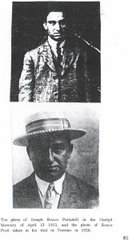
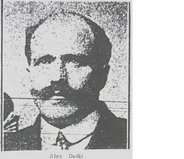
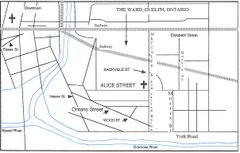
This item is now available only by subscribing to the Mercury sorry.At some point I'll post the article.
Monday, March 12, 2007
Guelph Mercury
Rocco Perri Excerpt
Current Posts!
This item is now available only by subscribing to the Mercury sorry.At some point I'll post the article.
This item is now available only by subscribing to the Mercury sorry.At some point I'll post the article.


Bestselling Author
I've never been a best selling author before, but now I'm just that at the Bookshelf in Guelph, I'm a one store hit. It's lonely at the top, waiting for the next Harry Potter Book to come along and topple me.
Jerry
Current Posts!
Jerry
Sunday, March 11, 2007
Newspaper Editorial - see Previous Post below
It is hard not to appreciate the enthusiasm with which the editor of the Guelph Mercury embraced my work and the efforts it took me to research the book.
There is however an intensity that I'm not entirely certain I share, or at least, my own intensity is tempered by the tragedies in the stories I recount in the book.
It could be that journalists in Guelph have for years found themselves frustrated by knowing pieces of the truth about this city but not being able to write about it because all the evidence available to them was anecdotal, rumours with substance but no seeming entry point for an 'objective' story. That frustration may have found an outlet in my book, like an opened door through which the journalists now seem prepared to enter.
And in some ways I can't blame them. I began with a similar emotion, but my emotions got subjugated to spiritual necessities even more than socio-political ones the longer I worried my way into the subject.
In the book I constantly make a distinction between the mobsters from San Giorgio Morgeto - whom I call Morgeti, and the non-mobsters, the majority of the villagers and their Guelph descendants, the Sangiorgiosi.
The spiritual necessity that informed the book and resonated into the tone of the work, is that the two distinctions nonetheless constitute one people. What Northrup Frye through Coleridge explained as the necessity for distingiushing that which cannot be divided. These aren't just stories about crime families, they're stories about families, uncles, brothers, cousins. The book is dedicated to the victims of vendetta. It's for their loved ones in some ways.
But decide for yourself what you think of the editorial, it follows this post below, and the online original can be accessed through a direct link by clicking on that post's title.
Jerry
Current Posts!
There is however an intensity that I'm not entirely certain I share, or at least, my own intensity is tempered by the tragedies in the stories I recount in the book.
It could be that journalists in Guelph have for years found themselves frustrated by knowing pieces of the truth about this city but not being able to write about it because all the evidence available to them was anecdotal, rumours with substance but no seeming entry point for an 'objective' story. That frustration may have found an outlet in my book, like an opened door through which the journalists now seem prepared to enter.
And in some ways I can't blame them. I began with a similar emotion, but my emotions got subjugated to spiritual necessities even more than socio-political ones the longer I worried my way into the subject.
In the book I constantly make a distinction between the mobsters from San Giorgio Morgeto - whom I call Morgeti, and the non-mobsters, the majority of the villagers and their Guelph descendants, the Sangiorgiosi.
The spiritual necessity that informed the book and resonated into the tone of the work, is that the two distinctions nonetheless constitute one people. What Northrup Frye through Coleridge explained as the necessity for distingiushing that which cannot be divided. These aren't just stories about crime families, they're stories about families, uncles, brothers, cousins. The book is dedicated to the victims of vendetta. It's for their loved ones in some ways.
But decide for yourself what you think of the editorial, it follows this post below, and the online original can be accessed through a direct link by clicking on that post's title.
Jerry
Editorial in the Guelph Mercury
Editorials
We need to remember all the history
(Mar 10, 2007)
Guelph's Jerry Prager may well agitate some local residents with a book he's just released. Good on him.
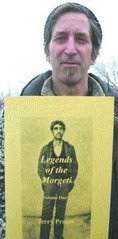
Prager has dared to revisit in minute detail some of the most sordid tales and times in Guelph's past in his Legends of the Morgeti, Volume One 1900-1922. It's a book described by its publishing house as one that confronts some "uncomfortable" truths about Guelph and delivers on that promise.
Prager's book was officially released this week with a public reading at a downtown Guelph church. The affair sparked animated discussion. Most who attended are connected to family trees that have maintained through oral tradition some of the tales Prager dissects in the book. So vigorous was the discussion about this infamous aspect of Guelph's past Prager subsequently established a blog to continue the forum. It's at morgeti.blogspot.com.
An excerpt of Prager's book appears in today's newspaper as the cover of our Here section. We hope to contribute to the review of Guelph's yesteryear that the book is inspiring.
Many -- but not all -- Guelph residents are aware of the community's mob town reputation. This effort explores the validity and the roots of that reputation. It revives knifings, shootings and other crimes that some would wish left as closed cases. But doing so would be to lose something valuable. This community -- any community -- is a product of its history. And, history books do an injustice when they only celebrate great moments, people and hallowed accomplishments.
If you're unaware or under-aware of the story of how clans of Calabrian mafia arrived here from the Village of San Giorio Moregto and helped establish organized crime in Guelph and elsewhere, consider becoming a student of the subject as Prager has -- or through Prager. This work is the result of three years of digging through decades-old newspaper accounts, obscure genealogical records and other documents.
Prager is seeking to teach and perhaps also to provoke in this effort. We applaud him for trying to do both. A citizenry is richer when it is informed about its roots. Legends hold the potential to enrich us about local heritage -- albeit one several locals might want muted.
copyright Guelph Mercury
Current Posts!
Editorials
We need to remember all the history
(Mar 10, 2007)
Guelph's Jerry Prager may well agitate some local residents with a book he's just released. Good on him.
Prager has dared to revisit in minute detail some of the most sordid tales and times in Guelph's past in his Legends of the Morgeti, Volume One 1900-1922. It's a book described by its publishing house as one that confronts some "uncomfortable" truths about Guelph and delivers on that promise.
Prager's book was officially released this week with a public reading at a downtown Guelph church. The affair sparked animated discussion. Most who attended are connected to family trees that have maintained through oral tradition some of the tales Prager dissects in the book. So vigorous was the discussion about this infamous aspect of Guelph's past Prager subsequently established a blog to continue the forum. It's at morgeti.blogspot.com.
An excerpt of Prager's book appears in today's newspaper as the cover of our Here section. We hope to contribute to the review of Guelph's yesteryear that the book is inspiring.
Many -- but not all -- Guelph residents are aware of the community's mob town reputation. This effort explores the validity and the roots of that reputation. It revives knifings, shootings and other crimes that some would wish left as closed cases. But doing so would be to lose something valuable. This community -- any community -- is a product of its history. And, history books do an injustice when they only celebrate great moments, people and hallowed accomplishments.
If you're unaware or under-aware of the story of how clans of Calabrian mafia arrived here from the Village of San Giorio Moregto and helped establish organized crime in Guelph and elsewhere, consider becoming a student of the subject as Prager has -- or through Prager. This work is the result of three years of digging through decades-old newspaper accounts, obscure genealogical records and other documents.
Prager is seeking to teach and perhaps also to provoke in this effort. We applaud him for trying to do both. A citizenry is richer when it is informed about its roots. Legends hold the potential to enrich us about local heritage -- albeit one several locals might want muted.
Friday, March 9, 2007
Crime Family Law
Under contemporary rights and freedoms the police must adhere to strict 'rules of evidence', and rightly so, which means that the police are incapable of stopping gangster capitalists. Equally, Royal Commissions which are created to investigate narrowly defined aspects of criminal activity like the construction industry et al, may shed light into a field of crime but they do little else than cause the darkness to retreat elsewhere, while creating problems for ongoing police investigations. I tend to agree with St. Paul that, "There is no salvation in law." The law cannot save society from the sins of its members, least of all from gangsters. All the law can do is to define right and wrong and create penalties for doing wrong.
What this book is designed to show is that a third way is required, one that makes use of generations of police work to support evidential trails that will allow communities to redeem families from criminal societies. This book traces the history of organized crime in Guelph via specific clans because I want to make the case that we need to create a legal definition of a Criminal Family. The designation would enable us to use the more pro-active tools of Family and Civil law, and combine them with the power of the Criminal Court. Public accessibility to court-administered Crime Family databases could be secured in Public and University Libraries, Archives and Museums and be available in hard copy and online.
A Criminal Family designation would combine generations of investigations and convictions with the sweeping power of Royal Commissions to shed light on crime activities in not just Guelph or Canada, but in a system that could extend to Italy itself.
Italy has been begging for action from Canada lawmakers, because gangsters so easily hijack our rights and freedoms, and have turned us into a conduit for the global drug trade. We need a way out of the 'revolutionary/gangster' revenge cycle in which drugs are sold to buy guns to fight battles so that political issues can be addressed in places where democracy has little traction. Those vendetta cycles not only lead to the corruption of the global democracy movement but they ensure the vitality of gangster capitalism.
A Crime Family designation would allow communities to seize the assets of such families and put the seized properties and monies into two trusts. One trust would be designed to ensure the survival of future generations of the families as they attempt to redeem themselves from their pasts. The other trust would be used to restore the integrity of local economies while preventing opportunities for other criminal groups to step into vacuums left by dismantled crime families. Some of that second Trust's money must also go into drug rehab programs, both for users, and for the farmers in various parts of the world who make their hard-scrabble livings growing coca for cocaine, opium for heroin/morphine, marijuana etc.
Appeals processes would be available to ensure that innocent households of any given family can defend their innocence. A moratorium on prosecution, based on the confessions of any elder of any given Crime Family would also be made available. It is not condemnation but redemption we're after here, grace not law. Of course there are always the unrepentant who will not only choose to always live by the sword but to die by it, and for them we cannot pretend that grace or law will have much effect on them.
In recent years Italy has been redeeming itself from its criminal societies by the use of peniti - penitents who, for one reason or another, confess to the various crimes of their clans. Those confessions tend to be made on the basis of personal survival, but just as often, there is an undercurrent of genuine confession involved, rooted as it so often is in the horrific consequences of vendetta, the shedding of the blood of the innocent and guilty alike, often family members. A Criminal Family designation therefor is not designed to crush crime families; it is designed to free them, not without consequences, but responsibly, whenever possible.
It should also be stated for the record that just because a family was involved in criminal activities during the period covered by Volume One (1900-1922) does not mean those families are still involved in organized crime. Vendetta itself has a way of demoralizing a family and that leads them to seek their own redemption.
Wednesday, March 7, 2007
Reading Launch
Just had a launch reading at the Dublin Street United Church, wasn't sure anyone was going to be there but twenty or so came, majority were San Giorgiosi. This is the second reading I've done with similar material from the book. And something curious always seems to happen when I end the reading with the dedication to the dead, with the reading of their names. I've done it at both readings and at both, a solemnity seems to take over, and a natural moment of silence ensues.
I wrote a play once called the Wake of the Asia about the worst marine disaster in Georgian Bay history, 120 people lost their lives (in 1882.) We actually performed the play in a tent alongside the Bay in Collingwood and the run coincided with the date of the tragedy so we invited descendants of the lost to attend a wreath ceremony, at which we read out the names of the 120 people who had died. Their names hadn't been spoken aloud in generations it seemed. There is something about memorializing the forgotten that opens the sacred into the ordinary.
The great difficulty of writing this book was to get the tone right, to make it something other than a True Crime book, to make it about family, to honour the survivors of vendetta, to show respect to the dead whose stories I can only tell as fragments, whether those men were cold blooded killers, or passionate unfortunates or unlucky opportunists.
I talked about how I hoped healing would come to the community by telling the stories but at the end of the evening two Sangiorgiosi asked me about that, about how some they've talked to felt that healing had already come about through forgetting. It's certainly one way to do it, and it's not a way I can condemn, and yet, I guess I believe that redemptive healing requires light to reach into the darkness in order to separate the shadows of human action from the darkness itself. So I suppose I'm talking about spiritual healing rather than just emotional scarring over. I think forgetfulness leads to a certain kind of hardness maybe, whereas spiritual healing is more like being released from prison, like the Orpheus story where he rescues his wife from Hades, only to lose her in the shadow of the rock opening to the outer world because she couldn't separate herself from her past.
Anyway,
To the man who left his scarf, I have it. Contact me via the gmail address above and I'll arrange to get it back to you. To everyone else thanks for coming. And thanks for buying the book.
Current Posts!
I wrote a play once called the Wake of the Asia about the worst marine disaster in Georgian Bay history, 120 people lost their lives (in 1882.) We actually performed the play in a tent alongside the Bay in Collingwood and the run coincided with the date of the tragedy so we invited descendants of the lost to attend a wreath ceremony, at which we read out the names of the 120 people who had died. Their names hadn't been spoken aloud in generations it seemed. There is something about memorializing the forgotten that opens the sacred into the ordinary.
The great difficulty of writing this book was to get the tone right, to make it something other than a True Crime book, to make it about family, to honour the survivors of vendetta, to show respect to the dead whose stories I can only tell as fragments, whether those men were cold blooded killers, or passionate unfortunates or unlucky opportunists.
I talked about how I hoped healing would come to the community by telling the stories but at the end of the evening two Sangiorgiosi asked me about that, about how some they've talked to felt that healing had already come about through forgetting. It's certainly one way to do it, and it's not a way I can condemn, and yet, I guess I believe that redemptive healing requires light to reach into the darkness in order to separate the shadows of human action from the darkness itself. So I suppose I'm talking about spiritual healing rather than just emotional scarring over. I think forgetfulness leads to a certain kind of hardness maybe, whereas spiritual healing is more like being released from prison, like the Orpheus story where he rescues his wife from Hades, only to lose her in the shadow of the rock opening to the outer world because she couldn't separate herself from her past.
Anyway,
To the man who left his scarf, I have it. Contact me via the gmail address above and I'll arrange to get it back to you. To everyone else thanks for coming. And thanks for buying the book.
Tuesday, March 6, 2007
The Source of my Research
Bibliography
Blood Brothers:
How Canada's Most Powerful Mafia Family Runs its Business
Peter Edwards, Toronto, Key Porter Books 1990
Bloodlines: The Rise and Fall of the Mafia's Royal Family
Antonio Nicaso, Lee Lamothe
The Canadian Connection: An Expose of the Mafia in Canada
and its International Ramifications by Jean Pierre Charboneau,
translation James Stewart ,Optimum Publishing 1976
Deadly Silence: Canadian Mafia Murders
Peter Edwards, Antonio Nicaso, Toronto: MacMillan Canada 1993
Encyclopedia Brittanica, Wm. Benton Publisher, 1962
The Enforcer: Johnny Pops Papalia A Life and Death in the Mafia
Adrian Humphreys, Harper Collins Publishers Ltd. 1989
King of the Mob: Rocco Perri and the Women Who Ran His Rackets
James Dubro, Robin F. Rowland, Penguin Books 1987
Mafia Assassin:
The Inside Story of a Canadian Biker, Hitman and Police Informer
Cecil Kirby, Thomas C. Renner, Toronto: Methuen 1986
Mob Rule: Inside the Canadian Mafia
James Dubro, A Totem Book, MacMillan Canada 1985
Rocco Perri: The Story of Canada's Most Notorious Bootlegger
Antonio Nicaso, John Wiley & Sons Canada Ltd. 2004
Yours in the Struggle: reminiscences of Tim Buck NC Press, Toronto 1977
The Lucky Immigrant: the Public Life of Fortunato Rao
Nichaolas DeMaria Harney & Frank Sturino
Multicultural History Society of Ontario, Toronto 2001
The Mafia in Canada, a Five Part Series
Alan Phillips MacLeans Magazine, Aug. 24 1963 to Mar. 7 1964
The Guelph Mercury on microfilm, 1905-2006
The Toronto Star, Pages of the Past website
The Globe and Mail, Canada's Heritage from 1844, wesbite
Palmers London Times Online
Proquest Historical Newspapers, The New York Times
Senato della Republica Camera dei Deputati (commisiion Parliamentare D'Inchiesta
Sul Fenomneo dell Criminalita Organizzata Docv. XXIII n.8)
http://www.csis-scrs.gc.ca/ Canadian Intelligence Security Service
www.oldlapdania.com mob watcher website
www.Ancestry.com genealogy
http://www.wikipedia.com/ Saint George
http://www.sicilia.idettaglio.it/ Morgantina ruins
http://www.ellisisland.org/ ship manifests
http://www.sgiorgiomorgeto.it/ San Giorgio Morgeto village website
http://www.carabinieri.it/ Italian paramilitary/ Giuseppe Musolino
Archives of Ontario series RG 22 392
Box 172 Giovinazza, James
Subscribe to:
Posts (Atom)