This is quite a fascinating idea. Libera appears to be an Italian anti-mafia organization that is using education, economic development on seized mob lands, and sports as a means of transforming Italy's organized crime culture.
Libera, click on the English flag for English language
Monday, March 19, 2007


Interesting List
I can't read the site because I don't read Italian but there is an interesting list of feud victims dated by year, that includes some of the Facchineri, who have been fight a war against the Raso-Albanese for control of San Giorgio Morgeto since 1963.
http://leonepaziente.blogspot.com
http://leonepaziente.blogspot.com
Thursday, March 15, 2007
San Giorgio Morgeto families who settled in Guelph
According to Pat Bowley's Guelph Historical Society essay The Italian
Community, in St. Patrick's Ward, Guelph Ontario, 1900-1939, a Mrs. C
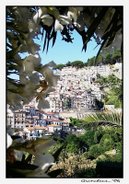
Ferraro had a photograph of the village of San Giorgio Morgeto, beneath which
she had made a list of the families who had settled in Guelph. It is that list I use
when I speak of the Morgeti and the San Giorgiosi who moved to Guelph.
Those clans according Mrs. C. Ferraro's are:
Addario Agostino Albanese Alviano Ammendolia Belcastro Bellantoni Anselmini Bombino Cacciatore Capra Cassone Collura Cardillo Consiglio DeMaria Fazzari Furfaro Giovinazzo Carere Consentino Ferraro Cotrone Fonte Leo Luccisano Macri Magnoli Longo Lieto Mammoliti Marchesano Morabito Muscatello Raco Maugeri Monteleone Nasso Pezzano Raso Rao Scarfo Seminara Sorbara Sorrenti Silvestro Simonetta Tedesco Varamo Valerioti
The names are not a complete list of San Giorgiosi and Morgeti who came
to Guelph, Tony Legato for instance, who was executed for a murder
committed in 1915 was from San Giorgio, Domenic Luberto is another
instance, as are the Spataros, the Zezares, the Vernis and the Varone's.
Community, in St. Patrick's Ward, Guelph Ontario, 1900-1939, a Mrs. C
Ferraro had a photograph of the village of San Giorgio Morgeto, beneath which
she had made a list of the families who had settled in Guelph. It is that list I use
when I speak of the Morgeti and the San Giorgiosi who moved to Guelph.
Those clans according Mrs. C. Ferraro's are:
Addario Agostino Albanese Alviano Ammendolia Belcastro Bellantoni Anselmini Bombino Cacciatore Capra Cassone Collura Cardillo Consiglio DeMaria Fazzari Furfaro Giovinazzo Carere Consentino Ferraro Cotrone Fonte Leo Luccisano Macri Magnoli Longo Lieto Mammoliti Marchesano Morabito Muscatello Raco Maugeri Monteleone Nasso Pezzano Raso Rao Scarfo Seminara Sorbara Sorrenti Silvestro Simonetta Tedesco Varamo Valerioti
The names are not a complete list of San Giorgiosi and Morgeti who came
to Guelph, Tony Legato for instance, who was executed for a murder
committed in 1915 was from San Giorgio, Domenic Luberto is another
instance, as are the Spataros, the Zezares, the Vernis and the Varone's.
Monday, March 12, 2007
Guelph Mercury
Rocco Perri Excerpt
Current Posts!
This item is now available only by subscribing to the Mercury sorry.At some point I'll post the article.
This item is now available only by subscribing to the Mercury sorry.At some point I'll post the article.
Bestselling Author
I've never been a best selling author before, but now I'm just that at the Bookshelf in Guelph, I'm a one store hit. It's lonely at the top, waiting for the next Harry Potter Book to come along and topple me.
Jerry
Current Posts!
Jerry
Sunday, March 11, 2007
Newspaper Editorial - see Previous Post below
It is hard not to appreciate the enthusiasm with which the editor of the Guelph Mercury embraced my work and the efforts it took me to research the book.
There is however an intensity that I'm not entirely certain I share, or at least, my own intensity is tempered by the tragedies in the stories I recount in the book.
It could be that journalists in Guelph have for years found themselves frustrated by knowing pieces of the truth about this city but not being able to write about it because all the evidence available to them was anecdotal, rumours with substance but no seeming entry point for an 'objective' story. That frustration may have found an outlet in my book, like an opened door through which the journalists now seem prepared to enter.
And in some ways I can't blame them. I began with a similar emotion, but my emotions got subjugated to spiritual necessities even more than socio-political ones the longer I worried my way into the subject.
In the book I constantly make a distinction between the mobsters from San Giorgio Morgeto - whom I call Morgeti, and the non-mobsters, the majority of the villagers and their Guelph descendants, the Sangiorgiosi.
The spiritual necessity that informed the book and resonated into the tone of the work, is that the two distinctions nonetheless constitute one people. What Northrup Frye through Coleridge explained as the necessity for distingiushing that which cannot be divided. These aren't just stories about crime families, they're stories about families, uncles, brothers, cousins. The book is dedicated to the victims of vendetta. It's for their loved ones in some ways.
But decide for yourself what you think of the editorial, it follows this post below, and the online original can be accessed through a direct link by clicking on that post's title.
Jerry
Current Posts!
There is however an intensity that I'm not entirely certain I share, or at least, my own intensity is tempered by the tragedies in the stories I recount in the book.
It could be that journalists in Guelph have for years found themselves frustrated by knowing pieces of the truth about this city but not being able to write about it because all the evidence available to them was anecdotal, rumours with substance but no seeming entry point for an 'objective' story. That frustration may have found an outlet in my book, like an opened door through which the journalists now seem prepared to enter.
And in some ways I can't blame them. I began with a similar emotion, but my emotions got subjugated to spiritual necessities even more than socio-political ones the longer I worried my way into the subject.
In the book I constantly make a distinction between the mobsters from San Giorgio Morgeto - whom I call Morgeti, and the non-mobsters, the majority of the villagers and their Guelph descendants, the Sangiorgiosi.
The spiritual necessity that informed the book and resonated into the tone of the work, is that the two distinctions nonetheless constitute one people. What Northrup Frye through Coleridge explained as the necessity for distingiushing that which cannot be divided. These aren't just stories about crime families, they're stories about families, uncles, brothers, cousins. The book is dedicated to the victims of vendetta. It's for their loved ones in some ways.
But decide for yourself what you think of the editorial, it follows this post below, and the online original can be accessed through a direct link by clicking on that post's title.
Jerry
Editorial in the Guelph Mercury
Editorials
We need to remember all the history
(Mar 10, 2007)
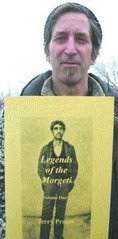
Guelph's Jerry Prager may well agitate some local residents with a book he's just released. Good on him.
Prager has dared to revisit in minute detail some of the most sordid tales and times in Guelph's past in his Legends of the Morgeti, Volume One 1900-1922. It's a book described by its publishing house as one that confronts some "uncomfortable" truths about Guelph and delivers on that promise.
Prager's book was officially released this week with a public reading at a downtown Guelph church. The affair sparked animated discussion. Most who attended are connected to family trees that have maintained through oral tradition some of the tales Prager dissects in the book. So vigorous was the discussion about this infamous aspect of Guelph's past Prager subsequently established a blog to continue the forum. It's at morgeti.blogspot.com.
An excerpt of Prager's book appears in today's newspaper as the cover of our Here section. We hope to contribute to the review of Guelph's yesteryear that the book is inspiring.
Many -- but not all -- Guelph residents are aware of the community's mob town reputation. This effort explores the validity and the roots of that reputation. It revives knifings, shootings and other crimes that some would wish left as closed cases. But doing so would be to lose something valuable. This community -- any community -- is a product of its history. And, history books do an injustice when they only celebrate great moments, people and hallowed accomplishments.
If you're unaware or under-aware of the story of how clans of Calabrian mafia arrived here from the Village of San Giorio Moregto and helped establish organized crime in Guelph and elsewhere, consider becoming a student of the subject as Prager has -- or through Prager. This work is the result of three years of digging through decades-old newspaper accounts, obscure genealogical records and other documents.
Prager is seeking to teach and perhaps also to provoke in this effort. We applaud him for trying to do both. A citizenry is richer when it is informed about its roots. Legends hold the potential to enrich us about local heritage -- albeit one several locals might want muted.
copyright Guelph Mercury
Current Posts!
Editorials
We need to remember all the history
(Mar 10, 2007)
Guelph's Jerry Prager may well agitate some local residents with a book he's just released. Good on him.
Prager has dared to revisit in minute detail some of the most sordid tales and times in Guelph's past in his Legends of the Morgeti, Volume One 1900-1922. It's a book described by its publishing house as one that confronts some "uncomfortable" truths about Guelph and delivers on that promise.
Prager's book was officially released this week with a public reading at a downtown Guelph church. The affair sparked animated discussion. Most who attended are connected to family trees that have maintained through oral tradition some of the tales Prager dissects in the book. So vigorous was the discussion about this infamous aspect of Guelph's past Prager subsequently established a blog to continue the forum. It's at morgeti.blogspot.com.
An excerpt of Prager's book appears in today's newspaper as the cover of our Here section. We hope to contribute to the review of Guelph's yesteryear that the book is inspiring.
Many -- but not all -- Guelph residents are aware of the community's mob town reputation. This effort explores the validity and the roots of that reputation. It revives knifings, shootings and other crimes that some would wish left as closed cases. But doing so would be to lose something valuable. This community -- any community -- is a product of its history. And, history books do an injustice when they only celebrate great moments, people and hallowed accomplishments.
If you're unaware or under-aware of the story of how clans of Calabrian mafia arrived here from the Village of San Giorio Moregto and helped establish organized crime in Guelph and elsewhere, consider becoming a student of the subject as Prager has -- or through Prager. This work is the result of three years of digging through decades-old newspaper accounts, obscure genealogical records and other documents.
Prager is seeking to teach and perhaps also to provoke in this effort. We applaud him for trying to do both. A citizenry is richer when it is informed about its roots. Legends hold the potential to enrich us about local heritage -- albeit one several locals might want muted.
Subscribe to:
Posts (Atom)